
Respect for Human Rights
Human rights policy and management framework
We view respect for human rights as one of the Group’s key responsibilities and are committed to initiatives based on the framework of the United Nations Guiding Principles on Business and Human Rights. Our Group Human Rights Policy states that we do not tolerate discrimination, harassment, or human rights abuses such as forced labor or child labor. We strive to respect the human rights of all stakeholders including employees, customers, investment and loan portfolio companies, and suppliers, and we are working to implement human rights due diligence and build mechanisms for taking corrective action and handling grievances.
In addition, the Group Sustainability Committee, chaired by the President and Representative Director, sets out the policies on human rights-related efforts and confirms the status of initiatives. With strong backing from management, the Company is committed to respecting human rights. The Board of Directors receives and oversees reports on the discussions from the Group Sustainability Committee.

Identification and assessment of human rights issues
In FY2024, we identified and assessed human rights issues as part of our human rights due diligence process.
First, in order to identify human rights issues, based on the international framework*1 and human rights issues of other companies in the same industry, we identified the negative impact on human rights that we are or could be involved in as “human rights issues” for each stakeholder (employees, customers, investment and loan portfolio companies, and suppliers).
In addition, we assessed the “severity” of human rights violations based on its scale, scope, and likelihood of remedy, and the “likelihood of occurrence” of human rights violations based on a survey of the occurrence of human rights violations involving financial institutions and the number of cases reported to our consultation desk.
As a result, we have identified the following three important human rights issues that we should prioritize.
- ■Invasion of privacy of customers and employees
- ■Discrimination and harassment of employees
- ■Human rights violations occurring at investment and loan portfolio companies and suppliers*2
The identification and assessment of human rights issues will be reviewed as necessary, taking into account changes in the internal and external environment and the results of the assessment of the effectiveness of prevention and mitigation measures to be implemented in the future.
- *1International Bill of Human Rights, ILO Declarations, Notes on Retail Banking (UNEP FI), etc.
- *2Impact on local communities, occupational health and safety of employees and the work environment, child labor, forced labor, human trafficking, business activities in conflict areas, etc.
Prevention and mitigation of negative impacts
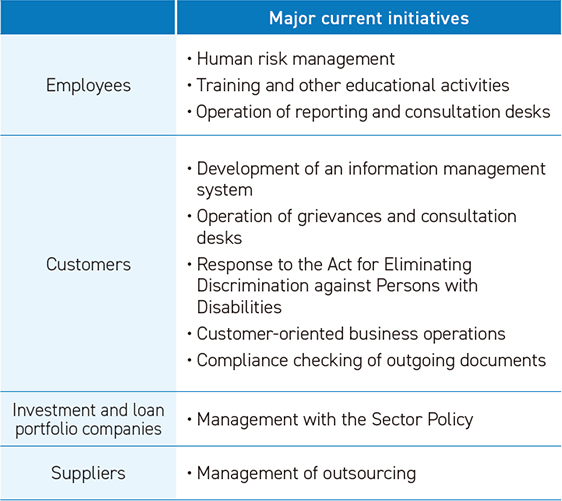
We are continuously strengthening our initiatives to prevent and mitigate negative impacts on human rights by formulating action plans based on the identification and assessment of salient human rights issues.
With regard to employees, we are working to create a workplace environment where individuals can maintain good mental and physical health and work with confidence. Measures include the introduction of a work-interval system, the review and digitization of operations, and behavioral and cultural reforms such as encouraging early departures and the use of paid leave. Through these initiatives, we strive to curb excessive workloads and reduce overtime hours . In addition, we regularly provide training and educational programs on respect for human rights, including harassment prevention and initiatives to promote understanding of LGBTQ+ issues, to raise employees’ awareness of human rights.
Regarding our investment and lending activities, we have established an investment and lending policy (Sector Policy) that considers potential negative environmental and social impacts. From a human rights perspective, the policy prohibits investments and lending to businesses involved in child labor, forced labor, or human trafficking. It also requires particularly careful decision-making, with a focus on risk avoidance and mitigation, for projects that may negatively impact Indigenous communities or involve involuntary resettlement associated with land acquisition.
Compliance with this policy is monitored on a regular basis. Based on the monitoring results, deliberations are conducted by the ALM and Risk Management Committee (Management Committee), while the Board of Directors oversees these activities.
Furthermore, starting in FY2024, we have strengthened initiatives such as reviewing outsourcing processes and enhancing monitoring and control mechanisms at each site to help prevent human rights violations.
Looking ahead, we will continue to strengthen awareness-raising initiatives, including for management, and evaluate the effectiveness of our actions to ensure the effective operation of human rights due diligence.
Remedial mechanisms and corrective actions
We have set up harassment consultation and internal reporting hotlines for the Group to handle various human rights concerns. Our system uses confidentiality agreements to strictly manage information and have established a remedy process that protects the privacy of the person making the consultation and all related parties. We also handle our customers’ human rights complaints at our Customer Consultation Office, which deals with customer inquiries and complaints. Furthermore, among the negative impacts on human rights that have become apparent, for those that need to be corrected, we will strengthen measures to prevent and mitigate the negative impacts on human rights and thoroughly prevent their recurrence by evaluating the effectiveness of those measures.
-
Sustainability
- Sustainability of the Group
- Sustainability Promotion Structure・Materialities
- Stakeholder Engagement
- Environment
-
Social
- Group Human Rights Policy
- Group Social Contribution Activity Policy
- Sustainable Growth of Local Businesses
- Solving the Problems of an Aging Society with a Declining Birthrate
- Contributing to the Growth of Local Economies
- Forming a Digital Society
- Human Capital Management(Human Resource Strategy)
- Respect for Human Rights
- Governance
- Human Resource Strategy
- Sustainability Library
- Group Non-Financial Data